The Indian automobile industry has witnessed remarkable transformation over the past two decades.
Manufacturers have gradually moved from basic mobility solutions toward lifestyle-oriented vehicles.
In this transition, concept cars have quietly shaped future strategies.
One such influential concept was the Maruti Suzuki Victoris.
Although it never entered mass production, the Victoris concept reflected strong long-term intent.
More importantly, it revealed how Maruti Suzuki was preparing for emerging SUV trends in India.
As a result, Victoris remains a significant milestone in the brand’s design evolution.
Understanding the Idea Behind Maruti Suzuki Victoris
Maruti Suzuki Victoris was introduced as a compact SUV concept to gauge market response.
At the time, the Indian SUV segment was still developing, dominated by utility-focused vehicles.
However, urban consumers were beginning to demand a new format.
Higher seating, bold styling, and improved road presence were becoming desirable features.
Therefore, Victoris was designed to reflect these changing expectations.
The concept emphasized urban practicality combined with SUV-inspired strength.
It primarily targeted young professionals and first-time SUV buyers.
As a result, Victoris represented vision rather than immediate commercial intent.
Design Language and Exterior Philosophy
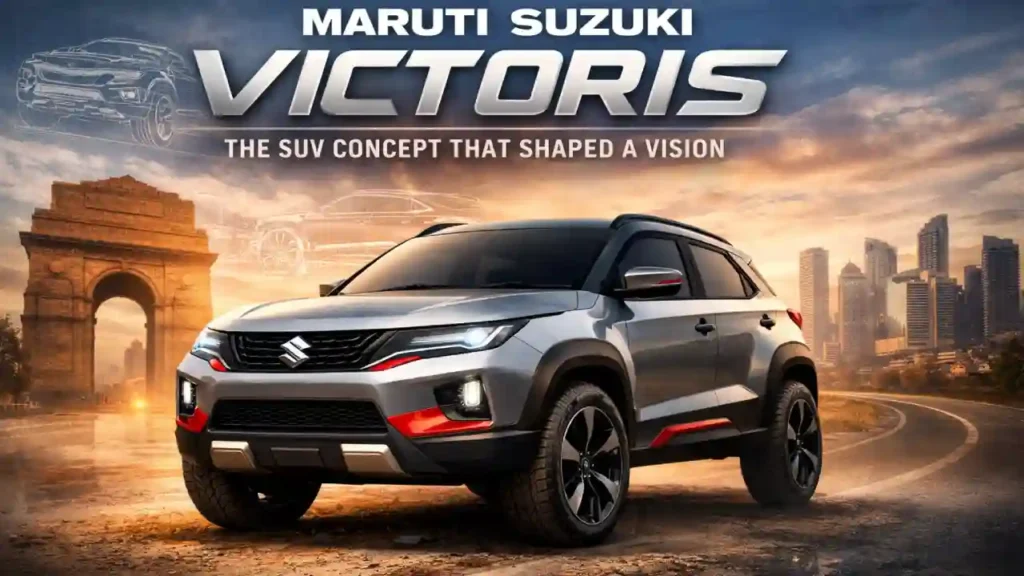
Victoris featured an aggressive and modern exterior design.
It marked a clear departure from Maruti’s traditionally conservative styling approach.
The front fascia appeared sharp and confident, supported by futuristic headlamp elements.
This design direction created strong visual impact and presence.
From the side, compact proportions were evident.
However, the raised stance and muscular wheel arches delivered a convincing SUV character.
Thus, the design balanced city usability with rugged appeal.
The rear profile remained clean and purposeful.
Unnecessary styling elements were avoided, ensuring a realistic and contemporary appearance.
Interior Concept and Cabin Direction
Inside the cabin, Victoris focused on usability and comfort.
The interior layout highlighted simplicity and driver-centric design.
The dashboard design was modern yet functional.
Instead of excessive futuristic elements, it emphasized clarity and ease of use.
An upright seating position was expected, offering better visibility.
This aligned well with SUV driving preferences and urban traffic conditions.
Although official interior specifications were limited, the intent was clear.
Maruti aimed to deliver a modern cabin without unnecessary complexity.
Expected Powertrain and Performance Approach
Maruti Suzuki did not officially reveal engine specifications for Victoris.
However, industry experts expected fuel-efficient petrol options to be considered.
Diesel engines were also speculated during that period.
Performance was not positioned as the primary focus.
Instead, efficiency, reliability, and low running costs remained key priorities.
The concept was expected to deliver smooth city performance.
Additionally, it was designed to handle Indian road conditions with ease.
Overall, the powertrain philosophy reflected Maruti’s practical engineering values.
Why Maruti Suzuki Victoris Never Reached Production
Market readiness played a crucial role in the decision.
During that era, Indian buyers still favored hatchbacks and sedans.
Compact SUVs were yet to achieve mass acceptance.
Fuel prices, infrastructure limitations, and buyer psychology added further risk.
As a result, Maruti Suzuki adopted a wait-and-watch approach.
However, the insights gained from Victoris proved extremely valuable.
Instead of becoming a commercial product, Victoris served as a strategic learning platform.
Influence on Maruti Suzuki’s Future SUV Strategy
Although Victoris was shelved, its impact was long-lasting.
It helped Maruti understand evolving customer aspirations and design expectations.
Years later, compact SUVs gained massive popularity in India.
Models such as the Vitara Brezza validated the segment’s potential.
In hindsight, Victoris appears ahead of its time.
The concept encouraged Maruti to blend practicality with bold design in future offerings.
Relevance of Victoris in Today’s Indian Market
Today, compact SUVs dominate Indian car sales charts.
Buyers actively seek comfort, style, safety, and fuel efficiency.
Victoris anticipated this shift years before it became mainstream.
If launched today with modern technology, the concept would still feel relevant.
Its compact dimensions suit congested urban environments.
Additionally, its design philosophy aligns closely with current SUV trends.
For enthusiasts, Victoris remains a fascinating “what could have been” story.
MG Cyberster: Electric Roadster Review
https://newsarmour.com/mg-cyberster-electric-roadster-review/
References :-
Maruti Suzuki Official Website (Brand Authority)
https://www.marutisuzuki.com
Autocar India – Concept Cars & SUV Evolution
https://www.autocarindia.com/car-news
Overdrive India – Automotive Design and Concepts
https://www.overdrive.in
CarWale – Maruti Suzuki SUV Line-up History
https://www.carwale.com/maruti-suzuki-cars
Team-BHP – Indian Automotive Discussions & Concepts
https://www.team-bhp.com