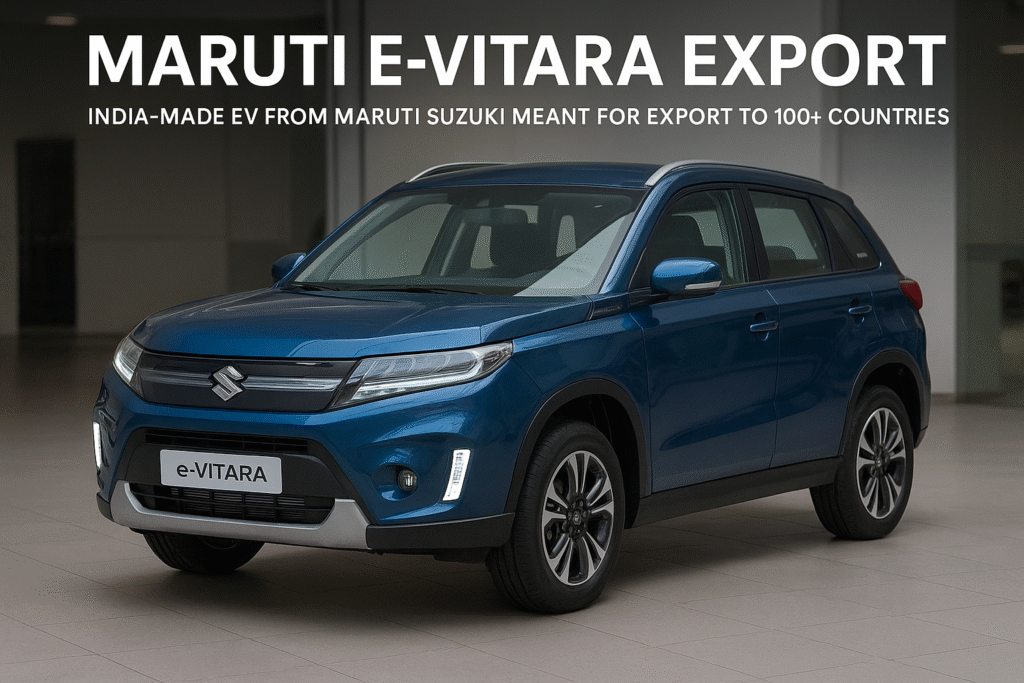
Maruti Suzuki, India’s largest carmaker, is finally entering the global electric vehicle market with its upcoming Maruti e-Vitara. The company plans to make this electric SUV in India and export it to over 100 countries. This move marks a major milestone for both Maruti Suzuki and the Indian automobile industry. It shows how India is moving from being a consumer market to a global manufacturing hub for clean mobility.
The e-Vitara will not just be another electric SUV. It is expected to represent Maruti Suzuki’s strategy for sustainable mobility and its ambition to lead in the EV revolution. Moreover, it will strengthen India’s image as a reliable production base for high-quality electric vehicles.
A New Chapter in Maruti Suzuki’s Legacy
For decades, Maruti Suzuki has dominated India’s passenger car market. From the legendary Maruti 800 to the modern Grand Vitara, the brand has shaped how India drives. Now, with the Maruti e-Vitara, the company is ready to enter a new era.
The electric SUV will be the first global EV developed under Suzuki Motor Corporation’s “Make in India for the World” vision. It will also reflect Suzuki’s commitment to carbon neutrality and India’s EV mission. As a result, the e-Vitara is not just a car; it’s a statement of intent.
This project also highlights Maruti Suzuki’s shift toward advanced technologies and sustainable practices. The company is investing heavily in EV research, local battery manufacturing, and renewable energy integration. Therefore, the e-Vitara is more than a product launch—it’s a technological transformation.
Design and Platform: Built on Strong Global Foundations
The Maruti e-Vitara is likely to be built on the Toyota-Suzuki e-TNGA platform, a modular structure designed specifically for electric vehicles. This platform ensures safety, efficiency, and flexibility in design. It will allow Maruti Suzuki to create a spacious, premium-looking SUV while keeping costs competitive.
In terms of design, early reports suggest a bold front fascia, clean LED headlamps, and aerodynamic lines. The SUV will also include a closed-grille setup, emphasizing its electric identity. Inside, Maruti is expected to focus on comfort, minimalism, and connected technology.
Moreover, the e-Vitara will aim to match global standards in quality and aesthetics. Since it will be exported to over 100 countries, the design language will appeal to a wide range of international customers.
Powertrain and Performance: Practical Range for Global Roads
While official details are yet to be revealed, the Maruti e-Vitara is expected to feature a 60-kWh battery pack with a range of around 550 kilometers on a single charge. The SUV may come with both two-wheel drive and all-wheel drive options, making it suitable for various terrains.
Charging speed will also be a key highlight. The vehicle will likely support fast charging, offering up to 80% charge in less than an hour. This capability makes it ideal for both city driving and long-distance travel.
Furthermore, the e-Vitara is expected to balance performance with efficiency. It will provide smooth acceleration, quiet operation, and regenerative braking—features that are now essential for modern EVs. As a result, Maruti aims to deliver a product that is both powerful and practical for global users.
Manufacturing and Export Strategy: India as the Global Hub
The e-Vitara will be manufactured at Maruti Suzuki’s state-of-the-art facility in Gujarat, one of the company’s key production centers. This plant is already known for producing high-volume export models like the Baleno and Swift. With the e-Vitara, it will become a major hub for electric vehicle production.
Maruti Suzuki plans to export the e-Vitara to more than 100 countries, including markets in Europe, Africa, and Asia. This wide export strategy will help the brand expand its global footprint and bring India’s EV manufacturing capabilities to the world stage.
Moreover, localizing production will allow Maruti to keep costs competitive while maintaining high quality. The company will source critical components such as batteries, motors, and power electronics from local suppliers whenever possible. Therefore, the e-Vitara project supports India’s “Atmanirbhar Bharat” (self-reliant India) vision.
Sustainability and Innovation: Beyond Electric Mobility
The Maruti e-Vitara is not just about zero emissions. It’s also about creating a sustainable ecosystem. The company is setting up a comprehensive EV infrastructure that includes battery recycling, renewable power use, and intelligent supply chain management.
Furthermore, Suzuki Motor Corporation has partnered with Toyota to leverage shared EV technologies and research. This collaboration ensures better efficiency and faster development cycles. It also allows Maruti Suzuki to compete with established EV players like Hyundai, Tata Motors, and MG.
As India pushes for a greener future, Maruti Suzuki’s EV project aligns perfectly with the government’s target of 30% EV adoption by 2030. Therefore, the e-Vitara will play a significant role in shaping India’s sustainable mobility future.
Challenges and Opportunities Ahead
Despite the excitement, challenges remain. The Indian EV market is still growing, and charging infrastructure is limited in many regions. Maruti Suzuki will need to ensure that customers feel confident about switching to electric mobility.
However, the company’s strong dealer network and trusted brand image provide a solid foundation. By focusing on customer education, service readiness, and after-sales support, Maruti can overcome these barriers effectively.
Moreover, the growing global demand for affordable EVs presents a huge opportunity. With the e-Vitara, Maruti Suzuki can establish itself as a reliable EV exporter from India, setting an example for other automakers.
Global Impact: Making India Proud
The export of the Maruti e-Vitara to more than 100 countries is more than a business move. It’s a symbol of India’s progress in advanced manufacturing and green technology. This achievement will put India on the global map as a major contributor to sustainable mobility.
It also reflects a larger shift in the global auto industry. Countries are now looking toward India for innovation, affordability, and quality in electric vehicle production. As a result, the e-Vitara will not just carry Maruti Suzuki’s legacy—it will carry India’s pride.
Conclusion: A Bold Step Toward a Greener Future
The Maruti e-Vitara represents more than just a new electric SUV. It stands for transformation, innovation, and global ambition. Built in India and meant for the world, it symbolizes how far the nation’s automotive industry has come.
As Maruti Suzuki steps into the global EV space, it brings hope for cleaner air, sustainable growth, and technological leadership. Therefore, the e-Vitara isn’t just another car launch—it’s the beginning of a new journey toward a greener, smarter, and more connected future.
The world is watching, and India is ready to lead.