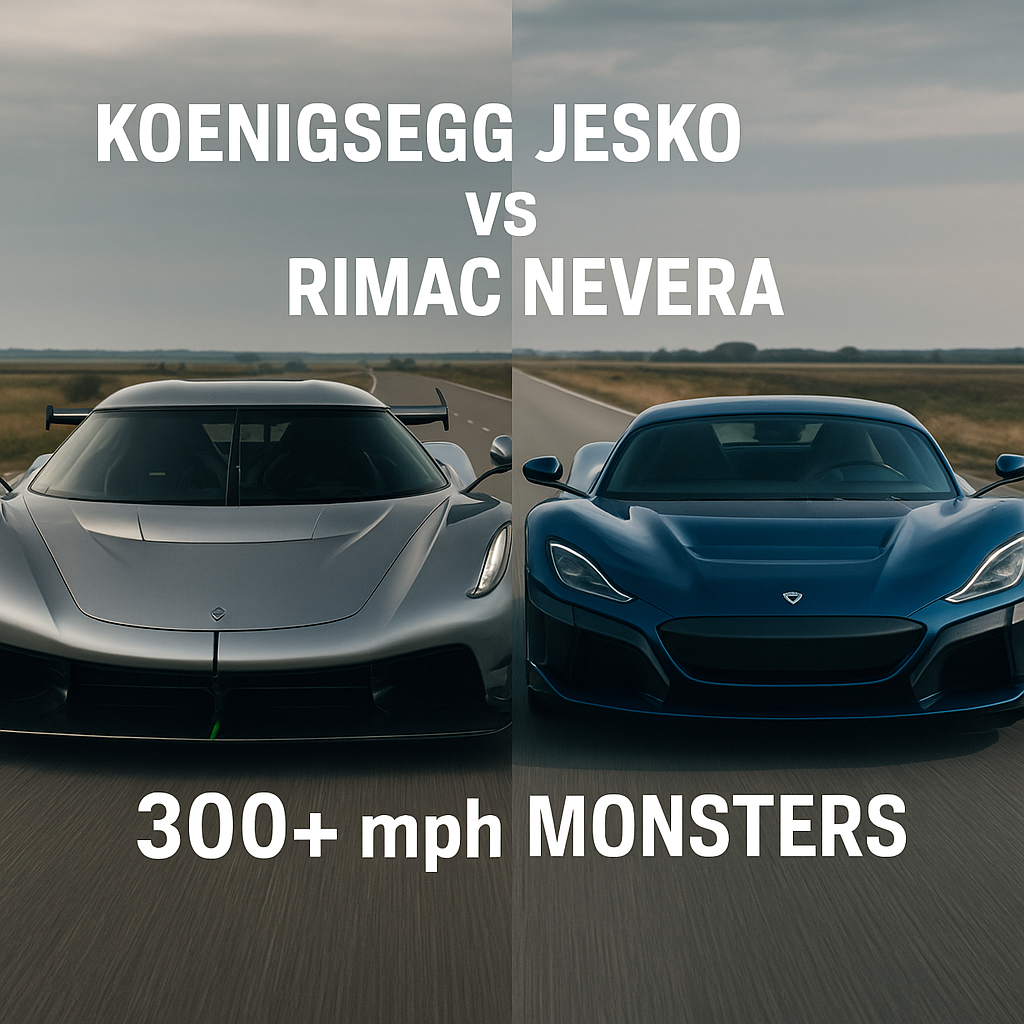
The automotive world is witnessing a new era. Speed, once defined by combustion engines, is now challenged by electric power. Two hypercars stand at the center of this storm the Koenigsegg Jesko and the Rimac Nevera. Both promise over 300 mph, redefining what performance truly means. But which one rules the road and the future?
The Rise of the 300 mph Era
For decades, reaching 200 mph was a dream. Then came Bugatti, Koenigsegg, and Hennessey, pushing limits to 250 mph and beyond. Today, a new war has begun one that aims at 300 mph and more.
Koenigsegg Jesko represents the pinnacle of internal combustion power. Rimac Nevera, on the other hand, symbolizes electric revolution. Their battle is not just about numbers; it’s about philosophy raw mechanical symphony versus silent electric precision.
Koenigsegg Jesko — Engineering Brilliance
The Jesko is Koenigsegg’s boldest creation yet. Named after Jesko von Koenigsegg, the founder’s father, this hypercar is built to dominate speed records.
It carries a 5.0-liter twin-turbo V8 that produces up to 1,600 horsepower on E85 fuel. The Light Speed Transmission (LST) is another marvel a 9-speed multi-clutch system that shifts almost instantly. As a result, power delivery feels continuous and seamless.
Moreover, Koenigsegg’s focus on aerodynamics is unmatched. The Jesko Absolut variant, designed for top-speed runs, has the lowest drag coefficient ever achieved by the brand. Every curve serves a purpose. Every detail screams performance.
Koenigsegg believes that speed is an art, and the Jesko proves it with its blend of innovation and brutal power.
Rimac Nevera — Electric Power Redefined
If the Jesko represents the old guard, the Rimac Nevera is the future. Built in Croatia by Rimac Automobili, this all-electric hypercar has changed how we see EVs.
Its four electric motors deliver a combined 1,914 horsepower and 2,360 Nm of torque. Each wheel has its own motor, allowing precise torque vectoring for perfect traction and handling. The Nevera accelerates from 0–60 mph in 1.74 seconds, faster than any production car on the planet.
However, Rimac didn’t stop at speed. The Nevera integrates AI-based driver assistance, adaptive suspension, and advanced aerodynamics. It even updates over the air, making it as intelligent as it is fast.
As a result, the Nevera is not only a record-breaking machine but also a symbol of technological evolution. It shows that electric cars can be emotional, thrilling, and breathtakingly fast.
Design and Aesthetics
Both hypercars are visual masterpieces, yet they express power differently.
The Jesko’s design reflects aerodynamic aggression. Its long tail, massive splitter, and sculpted body are built to slice through air with minimal resistance. The carbon-fiber chassis keeps it light yet strong, while the signature dihedral doors maintain Koenigsegg’s unique identity.
In contrast, the Nevera’s design speaks of fluid elegance. Its aerodynamic bodywork balances efficiency with grace. The smooth lines and integrated cooling ducts give it a futuristic appeal. Rimac combines beauty and functionality with near-perfect harmony.
While Jesko roars with presence, Nevera glides with silent confidence. One embodies power; the other, precision.
Performance and Handling
Speed alone doesn’t define greatness control does.
The Koenigsegg Jesko excels in balance and mechanical grip. Its active suspension and downforce technology create exceptional stability at high speeds. Drivers describe it as alive yet forgiving, a rare combination in extreme machines.
Meanwhile, the Rimac Nevera relies on intelligence. Its torque vectoring system adjusts power distribution hundreds of times per second. Therefore, every corner feels calculated and controlled. Despite weighing more than the Jesko, its instant torque gives it a supernatural edge in acceleration.
In real-world performance, Nevera dominates drag races, while Jesko might reclaim glory on long straights. The outcome depends on the battlefield.
Technology and Innovation
Both cars are technological marvels, but they take different paths.
The Jesko’s LST transmission, carbon-fiber structure, and aerodynamics represent the peak of combustion-era innovation. Every component is handcrafted for speed, and even its engine components are built in-house.
The Nevera, however, is a software-driven beast. It constantly monitors 500 parameters per second, adapting to conditions in real time. Its regenerative braking system recovers energy efficiently, extending range without losing thrill.
Moreover, Rimac’s approach to data and control is revolutionary. The Nevera learns your driving style and adjusts to enhance it. It’s not just a car it’s an intelligent companion.
Sound and Emotion
Here lies the most emotional difference.
Koenigsegg Jesko delivers a raw, mechanical soundtrack. The roar of the V8, the whoosh of the turbos, and the scream of the exhaust make it an orchestra of combustion. For many, that sound defines the essence of driving passion.
The Rimac Nevera, in contrast, whispers. Its electric motors hum softly, delivering instant power without drama. Some may miss the growl, but others find peace in the silence. It’s the sound of progress — calm, clean, and confident.
Therefore, the emotional connection depends on what you value nostalgia or innovation.
Price and Rarity
Both hypercars are exclusive and expensive.
The Koenigsegg Jesko costs around $3 million, depending on customization. Only 125 units will ever exist.
The Rimac Nevera carries a similar tag, at around $2.2 million, with just 150 examples built. Each one is hand-assembled, ensuring unmatched craftsmanship.
Owning either is not about transportation; it’s about joining a legacy of innovation and speed.
Who Wins the Battle?
There is no easy winner here. The Koenigsegg Jesko represents the ultimate evolution of internal combustion, a farewell to traditional power with unmatched performance. The Rimac Nevera represents the dawn of the electric future, proving that sustainability and speed can coexist.
Jesko might win on emotion and mechanical purity. Nevera might win on intelligence and acceleration. In truth, both are champions of their worlds.
The real victory lies in how they push humanity forward beyond limits once thought impossible.
Conclusion: The Future Belongs to Both
The battle between the Koenigsegg Jesko and Rimac Nevera isn’t about rivalry; it’s about evolution. Each defines an era one celebrating the perfection of combustion, the other embracing the brilliance of electricity.
As technology and passion merge, the future of hypercars looks brighter than ever. Whether you prefer the roar of the Jesko or the silence of the Nevera, both remind us why we fall in love with cars for their ability to make the impossible real.
The race for 300 mph is no longer a dream. It’s happening, and the Jesko and Nevera are leading the charge
BYD Seal — Complete Review – Variants, Specs, Price & FAQs
https://newsarmour.com/byd-seal-complete-review-variants-specs-price-faqs/
Sources
“Technical Specifications – Jesko Attack” – Koenigsegg official site: https://www.koenigsegg.com/technical-specifications-jesko-attack koenigsegg.com
“Jesko” model page – Koenigsegg official site:
https://www.koenigsegg.com/model/jesko-attack koenigsegg.com
“Koenigsegg Jesko: Review, Pricing, and Specs” – Car & Driver: https://www.caranddriver.com/koenigsegg/jesko Car and Driver
“Nevera – Rimac Automobili” – official site of Rimac:
https://www.rimac-automobili.com/nevera/ rimac-automobili.com
“Rimac Nevera: Review, Pricing, Photos, and Specs” – CarBuzz: