The world is moving toward cleaner, sustainable mobility. Electric vehicles (EVs) are no longer a distant dream but a global revolution. As countries push for zero emissions and reduced oil dependence, India stands out as a potential leader in the affordable EV market. With its vast population, cost-efficient manufacturing base, and growing technological expertise, India has every reason to become the next global hub for affordable electric vehicles.
A Rising Demand for Electric Mobility
India’s transportation sector is expanding at a fast pace. Millions of people rely on two-wheelers and small cars for daily commutes. This huge market creates the perfect foundation for affordable EVs. Consumers are looking for cost-effective and eco-friendly alternatives to petrol and diesel vehicles.
Moreover, rising fuel prices are making conventional vehicles less attractive. The government’s focus on green energy has also influenced buyer sentiment. Therefore, the adoption of EVs in India is not just a trend but a necessary shift toward sustainability.
Government Push and Policy Support
The Indian government has played a crucial role in promoting electric mobility. Initiatives like FAME II (Faster Adoption and Manufacturing of Electric Vehicles) provide subsidies for both manufacturers and buyers. These incentives reduce upfront costs and make EVs more appealing to consumers.
Also, several states have launched their own EV policies, offering tax benefits, free registration, and reduced road taxes. The production-linked incentive (PLI) scheme is another major boost for local manufacturing. As a result, global automakers are now setting up factories and partnerships in India to tap this growing opportunity.
Affordable Manufacturing Powerhouse
India’s manufacturing strength is one of its biggest advantages. The country already produces millions of two-wheelers and compact cars every year. This experience allows local companies to design EVs tailored to price-sensitive consumers.
Labor costs are relatively low compared to developed nations. Therefore, automakers can build EVs at competitive prices without compromising on quality. Moreover, the availability of skilled engineers and local suppliers makes India a natural choice for scaling production efficiently.
In recent years, major players like Tata Motors, Mahindra, and Ola Electric have invested heavily in EV production. These efforts are making affordable electric mobility a reality for the average Indian consumer.
Growing EV Infrastructure
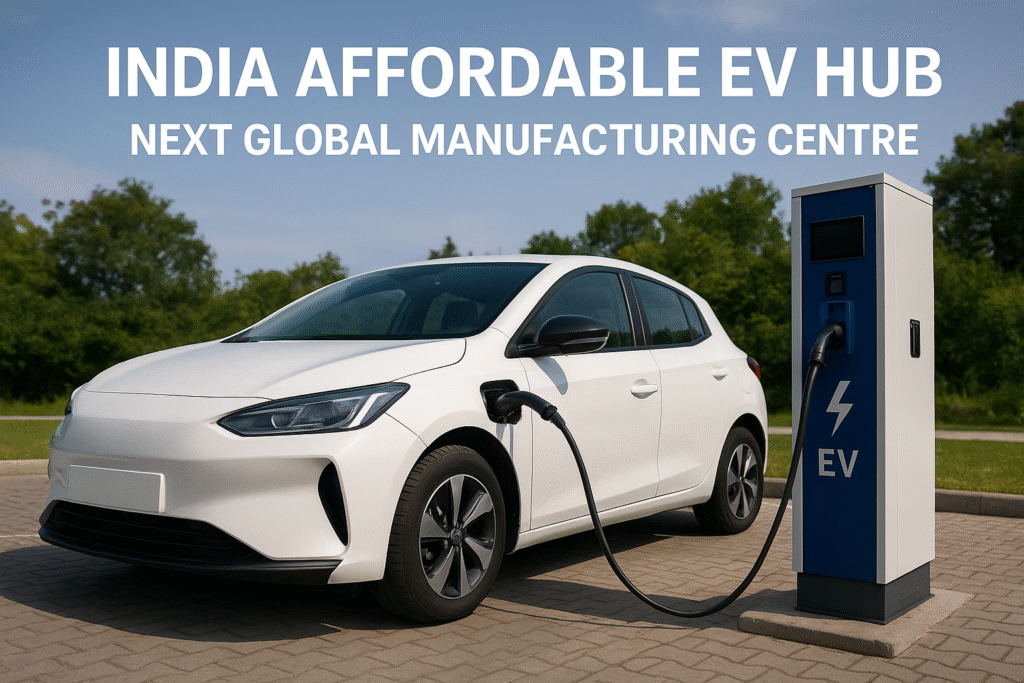
A strong EV ecosystem requires more than just vehicles. Charging infrastructure plays a key role in mass adoption. India has made impressive progress in this area. Charging stations are now being installed across highways, cities, and residential zones.
Companies such as Tata Power and Indian Oil are setting up charging points nationwide. Moreover, start-ups are entering the market with innovative battery-swapping and fast-charging solutions. As a result, range anxiety is gradually decreasing among potential buyers.
The government’s plan to establish over 20,000 charging stations in the coming years shows clear commitment. This focus on infrastructure will accelerate the shift from traditional vehicles to electric mobility.
Domestic Innovation and R&D Growth
India’s EV industry is not just about manufacturing. It is also becoming a center of innovation. Start-ups and research institutions are developing new battery technologies, software systems, and energy-efficient designs.
Moreover, Indian companies are exploring locally available materials to reduce dependence on imported lithium. This approach could make EVs even more affordable. Partnerships between academia and industry are driving advancements in energy storage and motor design.
As a result, India is slowly building a self-reliant ecosystem that supports every stage of EV development — from design to recycling.
Export Potential and Global Opportunities
Affordable EVs made in India could soon reach global markets. Developing nations in Africa, Southeast Asia, and South America have similar mobility needs and price expectations. Therefore, India’s cost-effective EV models can find strong demand abroad.
Also, the government’s push for “Make in India” and export-oriented policies align perfectly with this vision. International brands are already showing interest in sourcing from India due to competitive prices and skilled labor.
As the global EV market expands, India’s potential to become a leading exporter of budget-friendly EVs grows even stronger.
Challenges and the Road Ahead
Despite its potential, India faces a few challenges. Battery costs remain high, and raw material sourcing depends largely on imports. Also, the lack of consistent power supply in rural areas limits EV charging expansion.
However, the situation is improving. Research on solid-state batteries and local mineral exploration is underway. Moreover, renewable energy projects are reducing power dependency. With continuous policy support and private investments, these obstacles will gradually fade.
Public awareness and trust are equally important. Many consumers still worry about range, maintenance, and resale value. Therefore, education campaigns and transparent warranty systems are essential. Once these doubts fade, mass adoption will follow naturally.
Why India’s Future in EVs Looks Bright
India’s EV journey combines economic logic, environmental urgency, and entrepreneurial energy. The country’s youth-driven population, technological talent, and cost advantage make it ideal for scaling affordable EVs.
Moreover, collaboration between the government, private sector, and innovators is stronger than ever. This unity is creating a ripple effect across industries — from battery production to recycling. Therefore, India’s rise as a global EV hub is not a matter of “if” but “when.”
With the right focus on sustainability, quality, and innovation, India could redefine the future of global mobility.
Conclusion
The electric revolution is here to stay, and India has a unique opportunity to lead it. With strong policy support, manufacturing expertise, and a focus on affordability, the country is on the path to becoming the world’s hub for cost-effective EVs.
As the world looks for greener, cheaper, and smarter mobility solutions, India’s progress offers hope and inspiration. The road ahead is challenging, but the direction is clear. The wheels of change are already turning and they are electric.
Let’s drive the future responsibly. Let’s make India the heart of the global EV movement.
BYD China EV Story — How China Became the King of Electric Cars
https://newsarmour.com/byd-china-ev-story/
References :-
Electric Vehicle Industry in India and its Growth – IBEF
India’s EV Market: Trends and Future Prospects – S&P Global
Government approves E-Vehicle policy to Promote India as a Manufacturing Destination – PIB
India to become fourth-largest EV producer by 2030: Report – Economic Times