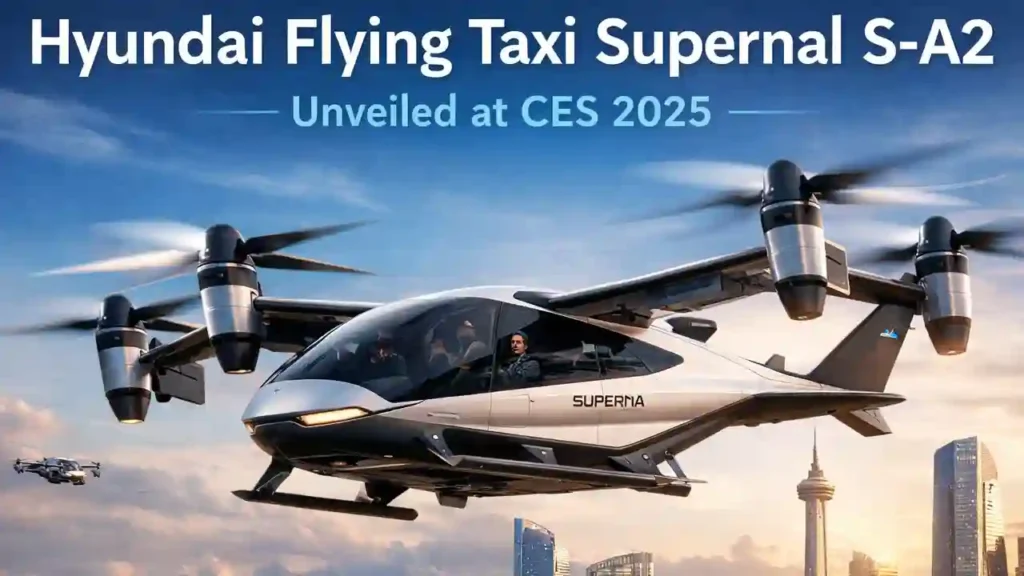
Urban transportation is facing increasing pressure from congestion, pollution, and time inefficiency. As cities expand vertically and horizontally, traditional road-based mobility struggles to keep pace. Therefore, global automakers are now exploring the skies for solutions. At CES 2025, Hyundai introduced a major step in this direction by unveiling its flying taxi concept, the Supernal S-A2. This reveal signaled a serious move toward practical urban air mobility rather than futuristic speculation.
The unveiling also demonstrated Hyundai’s intent to lead the transition into three-dimensional transportation. Unlike concept-only showcases of the past, this aircraft reflects real engineering, certification planning, and deployment strategy.
Hyundai’s Long-Term Urban Air Mobility Vision
Hyundai’s flying taxi initiative is rooted in a broader mobility vision led by Hyundai Motor Group. The company believes that future transportation must be clean, efficient, and scalable across multiple dimensions. As a result, urban air mobility has become a core pillar of its long-term strategy rather than a side experiment.
Hyundai’s approach differs from many startups because it combines aerospace development with large-scale manufacturing expertise. Moreover, the company focuses heavily on safety, regulation, and public acceptance from the beginning. This mindset positions Hyundai to move faster toward commercialization while avoiding common industry pitfalls.
Understanding the Supernal Division
Supernal is Hyundai’s dedicated urban air mobility subsidiary, created to develop electric vertical takeoff and landing aircraft. It operates with aerospace-level safety standards while benefiting from automotive production efficiency. Therefore, Supernal bridges the gap between aviation precision and industrial scalability.
This structure allows faster iteration, improved cost control, and clearer certification pathways. Consequently, the Supernal S-A2 represents more than a prototype; it reflects a pre-commercial platform designed for real-world operations.
What Is the Supernal S-A2 Flying Taxi?
The Supernal S-A2 is an electric vertical takeoff and landing aircraft designed for short-range urban and regional travel. It uses distributed electric propulsion with tilting rotors, which enables vertical lift and efficient forward flight. This design also enhances stability while reducing mechanical complexity.
The aircraft is configured to carry four passengers and one pilot. However, future iterations may adopt autonomous systems as regulations evolve. This progression could significantly lower operating costs and expand accessibility.
Design Approach and Passenger Comfort
Hyundai understands that public trust depends on familiarity and comfort. Therefore, the Supernal S-A2 avoids intimidating aerospace aesthetics. Instead, it blends clean automotive-inspired design with functional aerodynamics.
Inside the cabin, the focus remains on visibility, space, and comfort. Large windows reduce anxiety and provide an open experience. Additionally, seating and layout resemble premium electric vehicles, which helps passengers feel at ease during flight.
Performance Capabilities and Technical Goals
Performance metrics play a decisive role in urban air mobility viability. The Supernal S-A2 targets a cruising speed of approximately 120 miles per hour. This enables rapid point-to-point travel across congested urban regions.
The estimated range of around 60 miles suits typical city and suburban routes. As a result, battery limitations align well with real commuting patterns. Noise reduction also remains a priority, making the aircraft significantly quieter than traditional helicopters.
Safety Systems and Certification Planning
Safety remains the foundation of Hyundai’s flying taxi program. The Supernal S-A2 incorporates multiple redundant propulsion systems to ensure controlled flight even during component failures. Flight control systems combine advanced automation with human oversight to balance reliability and trust.
Certification efforts align with global aviation authorities from an early stage. Supernal works closely with regulators to meet strict airworthiness standards. Therefore, the transition from prototype to commercial service becomes smoother and more predictable.
Why CES 2025 Was a Strategic Reveal
The aircraft debuted at CES 2025, highlighting the convergence of mobility, software, and clean technology. This choice emphasized that flying taxis are not merely aircraft but integrated transportation systems.
The reveal placed Hyundai alongside leading global players in urban air mobility. However, Hyundai’s advantage lies in production scale, supplier networks, and regulatory experience. As a result, industry analysts see the Supernal S-A2 as one of the most credible flying taxi programs today.
Integration With Future Smart Cities
Flying taxis must integrate seamlessly into existing transportation networks. Hyundai plans to connect vertiports with metro stations, autonomous vehicles, and public transit systems. This approach ensures smooth first-mile and last-mile connectivity.
Digital air traffic management will coordinate routes using AI-driven systems. Therefore, airspace congestion can be prevented before it becomes a problem. This integration transforms air mobility into an extension of smart city infrastructure rather than a standalone service.
Environmental Impact and Sustainability Goals
Electric propulsion significantly reduces emissions compared to conventional vehicles. Moreover, by easing road congestion, flying taxis indirectly lower overall urban pollution. Hyundai also plans renewable energy-powered charging infrastructure to maximize environmental benefits.
Noise pollution receives equal attention. The Supernal S-A2’s low acoustic footprint helps protect urban sound environments. Consequently, cities can adopt air mobility without sacrificing livability.
Commercial Timeline and Market Outlook
Hyundai aims to introduce commercial urban air mobility services later this decade. Initial operations will likely focus on premium routes and business travel. However, economies of scale should gradually reduce costs and expand access.
Autonomous flight capabilities will follow in phases. This transition depends on regulatory approval and public confidence. Therefore, Hyundai continues to prioritize transparency and safety communication.
Looking Ahead: Mobility Beyond Roads
The unveiling of the Supernal S-A2 marks a defining moment for future transportation. It demonstrates that flying taxis are moving from concept to reality. Hyundai’s disciplined, safety-first approach strengthens confidence in this transition.
Urban mobility is no longer limited to streets and highways. The sky is becoming part of everyday transportation planning. As cities evolve, innovations like the Supernal S-A2 will reshape how people move, connect, and live. Now is the time to imagine mobility without limits and prepare for a future that truly takes flight.
Maruti Suzuki Victoris: The SUV Concept That Shaped a Vision
https://newsarmour.com/maruti-suzuki-victoris-suv-concept/
References :-
Official air mobility program by Hyundai Motor Group
https://www.hyundai.com/worldwide/en/company/innovation/supernal
Product and concept details from Supernal
https://www.supernal.aero
Event coverage and official announcements from CES 2025
https://www.ces.tech
Industry overview on urban air mobility by NASA
https://www.nasa.gov/aeronautics/urban-air-mobility
Regulatory framework insights from Federal Aviation Administration
https://www.faa.gov/air-taxis