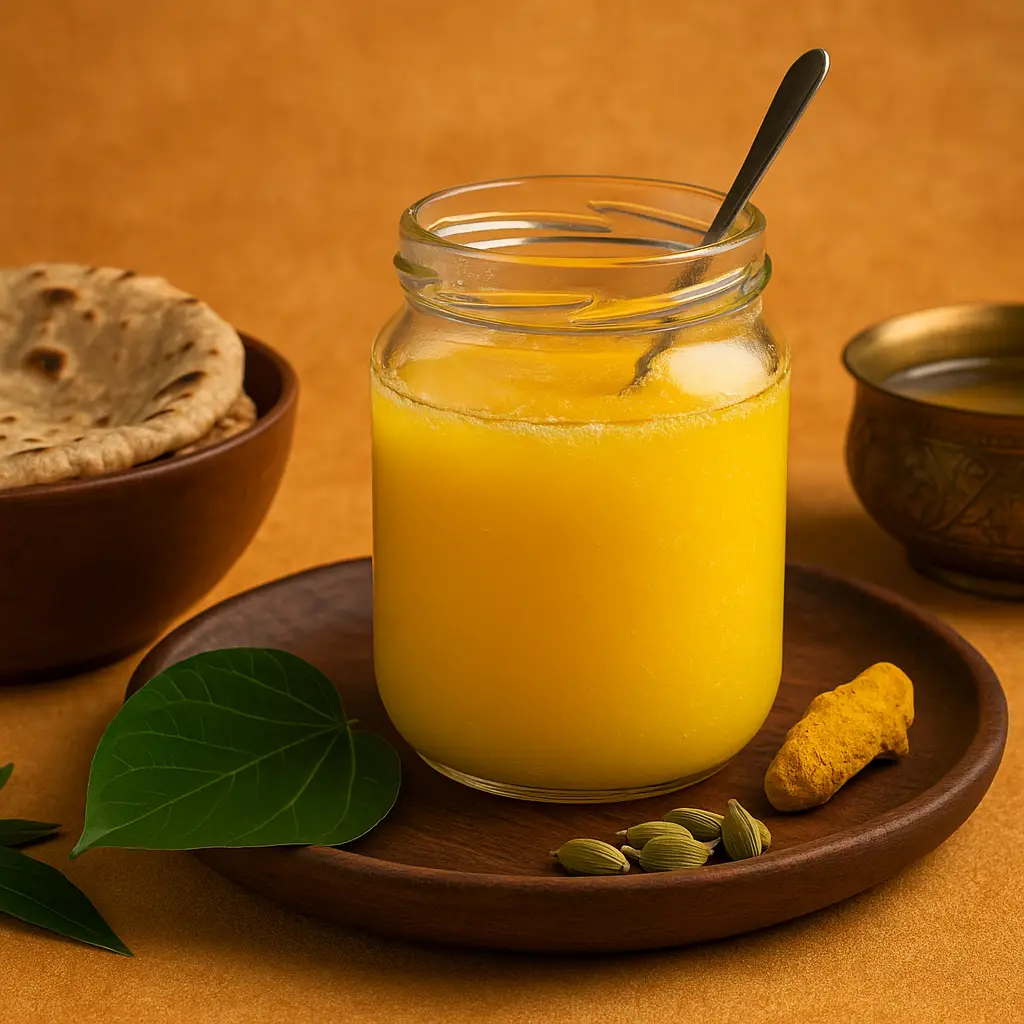
From the golden shine on hot rotis to the comforting aroma in dal tadka, Desi Ghee has been part of every Indian kitchen for centuries. For our grandparents, ghee was not just food—it was medicine, culture, and nourishment.
What’s fascinating is that the wisdom of Ayurveda, which called ghee “Amrit” (nectar of life), is now supported by modern scientific studies and guidelines from health organizations. Today, Desi Ghee stands tall as one of the few foods that beautifully balance tradition and science, taste and health.
In this blog, let’s explore ghee through both Ayurvedic and modern medical perspectives—its history, nutritional profile, benefits, myths vs facts, and how you can add it to your lifestyle guilt-free.
What Exactly is Desi Ghee?
Desi Ghee is a form of clarified butter prepared from cow or buffalo milk. Traditionally, the process is slow and natural:
- Fresh milk is set into curd.
- The curd is churned into butter.
- The butter is gently heated until the pure golden ghee separates.
Unlike refined oils, ghee contains no chemicals, preservatives, or artificial processing. It’s pure, aromatic, and nutrient-rich—making it one of the safest fats when consumed in moderation.
Desi Ghee in Ayurveda: Food as Medicine
Ayurveda, the ancient science of life, gives ghee a place of honor as a sattvic (pure, nourishing) food. It is described as a Rasayana—a rejuvenator that supports both body and mind.
- Balances Doshas: Ghee balances Vata (air) and Pitta (fire), while mildly increasing Kapha (earth).
- Agni (Digestive Fire): It strengthens digestion and helps the body absorb nutrients better.
- Ojas (Vital Energy): Builds immunity, vitality, and mental clarity.
- Ayurvedic Texts: Charaka Samhita and Sushruta Samhita praise ghee for improving eyesight, skin glow, brain power, and reproductive health.
Ayurveda also uses ghee as a medicine carrier (Anupana). When mixed with herbs, it carries their healing properties deeper into tissues.
Nutritional Value (Modern Science)
According to the USDA (2020), 1 tablespoon (14g) of Desi Ghee provides:
- Calories: ~120
- Saturated Fat: ~9 g
- Omega-3 fatty acids
- Conjugated Linoleic Acid (CLA)
- Fat-Soluble Vitamins: A, D, E, K
Together, these nutrients support heart health, bone strength, brain function, immunity, skin, and eye health.
Modern Research & WHO Guidelines
Modern science now echoes Ayurveda’s claims:
- WHO (2020): Natural fats like ghee, when taken in moderation, are safer than processed oils and trans fats.
- Harvard School of Public Health (2018): Moderate ghee consumption does not increase heart risk and is healthier than hydrogenated oils.
- National Institute of Nutrition (India): Found CLA in ghee, which has anti-obesity, anti-inflammatory, and anti-cancer benefits.
- Oxford University (2019): Highlighted fat-soluble vitamins in ghee as essential for bone and immune health.
- Journal of Food Science & Technology (2017): Confirmed ghee’s high smoke point makes it safe for high-heat cooking.
Medical Uses of Desi Ghee
- For Digestion
- Ayurveda recommends ghee for acidity, constipation, and ulcers.
- Butyric acid in ghee nourishes the intestinal lining and supports healthy gut bacteria.
- For Heart Health
- In moderation, ghee helps regulate cholesterol and circulation.
- Safer than refined oils full of harmful trans fats.
- For Brain & Nerves
- Called Medhya Rasayana (brain tonic) in Ayurveda.
- Improves memory, focus, and calmness.
- Modern studies agree that healthy fats are vital for nerve function.
- For Skin & Eyes
- Used in Ayurvedic therapy Netra Tarpan (eye rejuvenation).
- Topical ghee heals dryness, burns, and eczema.
- For Immunity
- Rich in Vitamin A & E, boosting defense against infections.
- Strengthens Ojas (vital energy).
- For Weight Management
- CLA in ghee boosts metabolism and reduces fat storage.
- Helps in controlled weight management when eaten sensibly.
Health Benefits at a Glance
- Enhances digestion and nutrient absorption
- Supports heart health
- Boosts immunity naturally
- Improves memory and concentration
- Nourishes skin and hair
- Aids healthy weight management
- Balances Ayurvedic doshas (Vata & Pitta)
Myths vs Facts
Myth 1: Ghee always causes weight gain.
Fact: Only excess ghee causes weight gain. Moderate intake boosts metabolism.
Myth 2: Refined oils are healthier than ghee.
Fact: Most refined oils contain trans fats. Ghee is natural and nutrient-rich.
Myth 3: Diabetics must avoid ghee.
Fact: Controlled ghee intake can actually improve insulin sensitivity.
How Much Ghee is Safe?
- WHO & ICMR Guidelines: Adults need 20–30 g of fats daily.
- A safe ghee intake: 1–2 teaspoons per day.
- Ayurveda suggests adjusting intake based on body type (prakriti) and seasons.
Desi Ghee in Modern Lifestyle
In today’s world of junk food, stress, and lifestyle disorders like obesity, diabetes, and heart problems, nutritionists now recommend switching from refined oils to natural fats like ghee.
A spoonful of ghee can:
- Make your dal-roti wholesome
- Enhance the flavor of rice and khichdi
- Add nutrition to vegetables and parathas
Think of ghee not as a guilty indulgence but as a healing, heritage food that connects you with your roots.
Conclusion
Desi Ghee is truly a blend of tradition and science. Ayurveda called it nectar, and modern research now validates its role in supporting digestion, immunity, heart health, brain function, and skin glow.
The secret lies in moderation. Just a spoonful a day can act as both food and medicine, making it one of the most powerful superfoods of our times.
So next time you drizzle ghee over hot rotis or steaming rice, remember—you’re not just enjoying taste, you’re nourishing your body with a gift of Ayurveda backed by science.
FAQs on Desi Ghee
Q1. Is Desi Ghee safe for heart patients?
Yes, when taken in moderation. Always consult your doctor for personalized advice.
Q2. Can diabetics consume ghee?
Yes, controlled intake helps improve insulin sensitivity.
Q3. Does ghee help in weight loss?
Yes, CLA in ghee boosts metabolism and reduces fat storage.
Q4. Can ghee be used in Ayurvedic treatments?
Absolutely. Ghee is used in Panchakarma detox, Netra Tarpan (eye therapy), and as a base for many herbal medicines.
Read this – https://newsarmour.com/coconut-water-benefits/
WHO Guidelines on Healthy Diets –
World Health Organization – Healthy Diet Facts
Harvard School of Public Health –
Harvard Nutrition Source – Fats and Cholesterol
USDA Nutritional Data on Ghee –
USDA Food Data Central – Ghee Nutrition Facts
Journal of Food Science & Technology (India) –
Springer – Journal of Food Science and Technology