

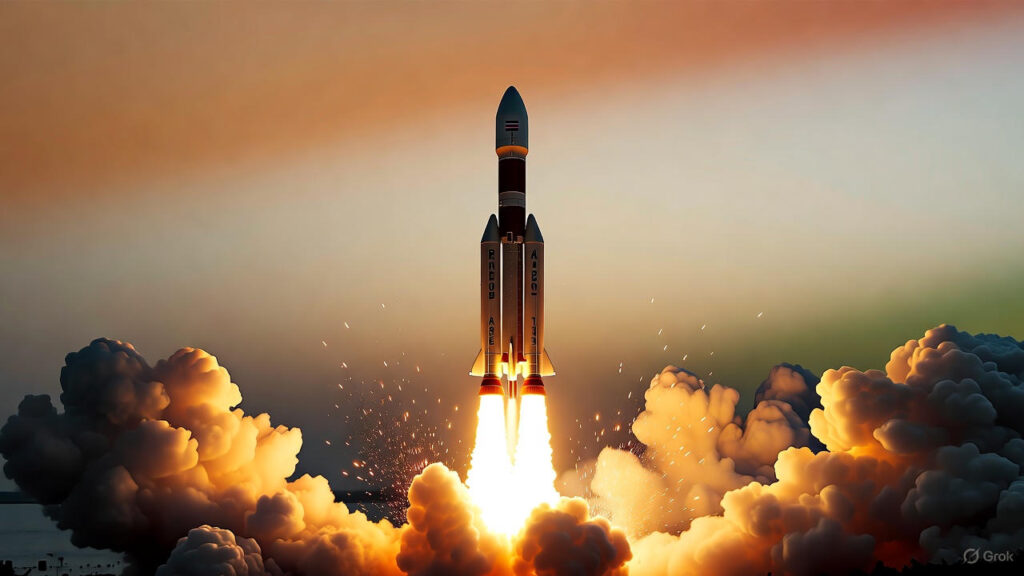
India’s space journey has always inspired the world. From humble beginnings in small labs to landing on the Moon, the Indian Space Research Organisation (ISRO) has proven its strength through innovation. Among its greatest achievements stands the Bahubali rocket, officially known as LVM3 or GSLV Mk III. This mighty launcher has changed India’s position in global space technology and defence readiness. It represents power, precision, and the spirit of self-reliance that defines modern India.
What Is the Bahubali Rocket?
The Bahubali rocket, or Launch Vehicle Mark 3 (LVM3), is India’s most powerful space vehicle. It can lift heavy payloads weighing up to four tonnes into geosynchronous orbit and around eight tonnes into low Earth orbit. It earned the nickname “Bahubali” because of its strength and reliability, much like the famous film character known for power and courage.
ISRO designed and developed LVM3 to carry large satellites and enable deep space missions. It consists of three stages: two solid boosters, a liquid core, and a cryogenic upper stage. The cryogenic engine, which uses super-cooled liquid hydrogen and oxygen, was developed entirely in India. This achievement marked a major step forward in indigenous technology.
Why Bahubali Was Needed
Earlier Indian rockets like PSLV and GSLV Mk II were successful but limited. They could carry smaller satellites only. As satellite technology advanced, communication and navigation payloads became heavier. India had to depend on foreign launchers, mainly from Europe, to send large satellites into orbit. This reliance was costly and created strategic risks.
The Bahubali rocket solved this problem. It gave India full independence in launching heavy communication and defence satellites. It also lowered launch costs and gave ISRO complete control over scheduling and secrecy. As a result, the rocket became a symbol of self-reliance and national pride.
How Bahubali Strengthens India’s Defence
While ISRO is a civilian agency, its work supports India’s defence in powerful ways. The ability to launch heavy satellites helps the country secure communication, navigation, and surveillance systems. These satellites are vital for national security and real-time information sharing.
Defence satellites like GSAT-7A and Cartosat series provide strategic communication and earth observation capabilities. They support the Army, Navy, and Air Force by improving coordination and situational awareness. The Bahubali rocket can launch such heavy and complex satellites without external help. This ensures that sensitive data and technology remain under Indian control.
Moreover, space-based navigation systems like NavIC (Indian Regional Navigation Satellite System) depend on reliable satellite launches. With LVM3, India can expand this network and improve its accuracy. Therefore, the rocket is not just a technological milestone but a crucial defence asset as well.
The Technological Significance of Bahubali
The Bahubali rocket stands as a masterpiece of engineering. Its cryogenic engine is one of the most complex technologies in rocketry. It uses liquid hydrogen at extremely low temperatures to generate high thrust efficiently. Developing this engine took years of research and testing.
This success placed India among a handful of nations capable of building such engines. The rocket’s design allows modular upgrades, which means ISRO can adapt it for future missions, including human spaceflight. It has also shown remarkable reliability, with every mission since its debut strengthening confidence in its performance.
Why Bahubali Is Special
Bahubali’s contribution to India’s lunar exploration is historic. It launched both Chandrayaan-2 and Chandrayaan-3 missions. These missions demonstrated India’s growing capability to explore deep space and land near the Moon’s south pole. Chandrayaan-3’s success in 2023 made India the first country to reach that region safely.
The rocket also symbolizes India’s journey from dependency to leadership. It carries not only satellites but also the dreams of millions. Each successful launch boosts India’s reputation in the global space industry. It shows that advanced technology can be developed through persistence and innovation, even with limited resources.
The Future of ISRO and Bahubali
ISRO’s roadmap for the next decade is ambitious and visionary. The Bahubali rocket will remain at the center of this journey. It will soon be used for Gaganyaan, India’s first human spaceflight mission. This mission aims to send Indian astronauts into low Earth orbit using LVM3. If successful, India will join the elite group of nations that have launched humans into space.
Beyond that, ISRO plans more interplanetary missions. Projects like Shukrayaan-1 to Venus and Mangalyaan-2 to Mars will rely on the power of LVM3. The rocket may also carry international payloads through ISRO’s commercial arm, NewSpace India Limited (NSIL). This move will strengthen India’s role in the global space market and attract partnerships with private companies.
Furthermore, India’s private space sector is growing rapidly. Startups supported by ISRO and IN-SPACe are developing new technologies in satellites, rockets, and propulsion. The Bahubali rocket will act as a platform for collaboration and expansion. It will open new opportunities for research, industry, and education.
How Bahubali Impacts the Indian Economy
The development of heavy-lift launch vehicles has economic benefits as well. It reduces the need to spend foreign currency on international launches. It also creates high-tech jobs and drives innovation across multiple sectors. The experience gained through Bahubali’s design and production helps Indian engineers and scientists master cutting-edge skills.
As India aims to grow its space economy to $40 billion by 2040, Bahubali plays a key role. It enables commercial satellite launches, boosts exports, and attracts foreign customers who seek reliable and affordable launch services. Moreover, it strengthens India’s image as a space power capable of competing globally.
The Strategic Importance of Self-Reliance
Space technology is not just about exploration; it is about strategic security. In today’s world, nations that control space assets also control information and communication. The ability to launch heavy satellites without foreign support ensures that India remains secure and self-sufficient.
Bahubali represents this strategic autonomy. It allows India to plan defence and communication projects independently. It also reduces vulnerability to international pressure or sanctions. Therefore, the rocket is both a technological and geopolitical achievement.
Challenges and Future Improvements
Although Bahubali is a major success, ISRO continues to improve it. Engineers are exploring reusable versions to reduce cost and increase efficiency. There are also plans to develop next-generation launch vehicles that can carry even heavier payloads. Such progress will make India’s space program more competitive and sustainable.
ISRO also faces challenges like managing cost, building global partnerships, and training new talent. However, its track record shows strong commitment and capability to overcome obstacles. The spirit of continuous innovation remains its greatest strength.
Conclusion: The Spirit of Bahubali and India’s Space Future
The Bahubali rocket is more than a machine; it is a symbol of India’s rise in science, defence, and global leadership. It reflects the country’s determination to stand tall through self-reliance and innovation. Every successful launch tells a story of courage, teamwork, and national pride.
As India prepares for human spaceflight and deeper cosmic exploration, the Bahubali rocket will continue to lead the way. It will inspire a new generation of scientists and dreamers to look up at the stars with confidence. The journey of Bahubali is the journey of India itself—strong, resilient, and ready for the future.
The sky is no longer the limit. For ISRO and for India, it is only the beginning.
Agni-5 Ballistic Missile: India’s Nuclear-Capable Strategic Weapon
https://newsarmour.com/agni-5-ballistic-missile/
Sources :-
Indian Space Research Organisation (ISRO) — LVM3 / GSLV Mk III vehicle specifications:
https://www.isro.gov.in/GSLVmk3_CON.html
NSIL (NewSpace India Ltd) Launch Services — Heavy-lift launcher GSLV Mk III capabilities:
https://www.nsilindia.co.in/launch-services
Wikipedia — “LVM3” page, payload capacities, history, missions:
https://en.wikipedia.org/wiki/LVM3
“GSLV MK3: Stages, Objective, Specification & Future launches!” — overview of specs and future missions:
https://testbook.com/ias-preparation/gslv-mk3
The Space Review — article on LVM3-M2 mission, commercial capability:
https://www.thespacereview.com/article/4472/1